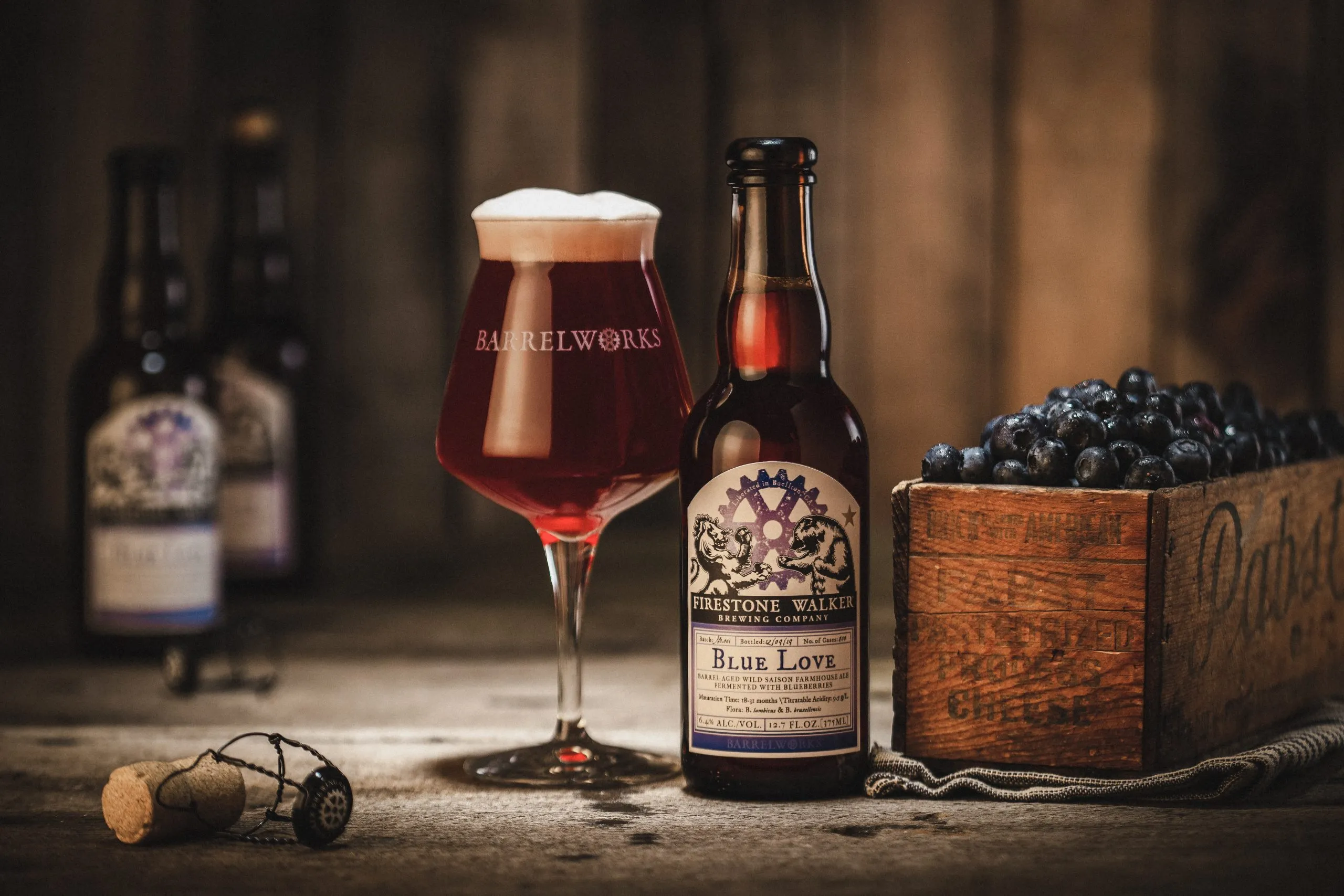
The Barrelworks project was officially born in 2013 as the most influential wild beer program in the brewing industry. This year, it presents the second edition of Blue Love, a blueberry Wild Ale.
But what is meant by “wild beer“?
First, a distinction must be made between sour beer and wild beer. Acidity is an element that can characterize a beer, but it is not its only peculiarity. Categorizing a beer only through the term “sour” does not allow for a full description of the experience and taste. In fact, there are wild beers that may present acidic or tart notes.
At the root of this difference are the yeasts used for production: most beers are made using yeasts defined as “traditional.” In the preparation of wild beers, however, a particular yeast called Brettanomyces (usually abbreviated as “Brett”) is used. It is naturally present on the skins of some fruits and was only discovered in 1904 thanks to research carried out in England on English Ales, so much so that it was defined as the “British fungus.”
This yeast behaves differently compared to other types: it acts more slowly in the fermentation process, making the process of transforming sugars into alcohol longer.
A beer produced with this yeast does not necessarily have a sour taste. To moderate acidity or increase its intensity, other yeasts such as Lactobacillus or Pediococcus are usually added. The former, more well-known, is what contributes to increasing the acidity of yogurt, while the latter provides a more intense tartness.
The addition of different yeast qualities can create an unusual bouquet of flavors, such as horse saddle, leather, barnyard, or smoky notes, which, if present in the right beer, can enhance its characteristics and provide very interesting sensations and aromas.
The term wild beer therefore has nothing to do with fermentation, but refers to the presence or absence of non-traditional yeasts. For the production of its beers, Barrelworks uses yeasts that are present in the air or naturally in the beer. Captured and collected, these yeasts have been used for years in the preparation of Wild Ale beers.
Blue Love is a Wild Ale produced using blueberries from Roy Farm in Yakima County (Washington), aged for more than 4 years in French oak barrels.
It is a top-fermented beer in the Flemish style originating from the Flanders region of Belgium, characterized by well-balanced acidity and bitterness and a low hop aftertaste.
Each liter of beer contains approximately 1.3 kg of blueberries and wild berries added to a red beer capable of releasing an intense aroma of wild berries, plum, and orange zest.
With its 6.7% ABV and moderate bitterness of 6 IBU, the second edition of this characteristic blueberry beer produced by Firestone Walker Barrelworks will catapult you directly into the forest undergrowth!