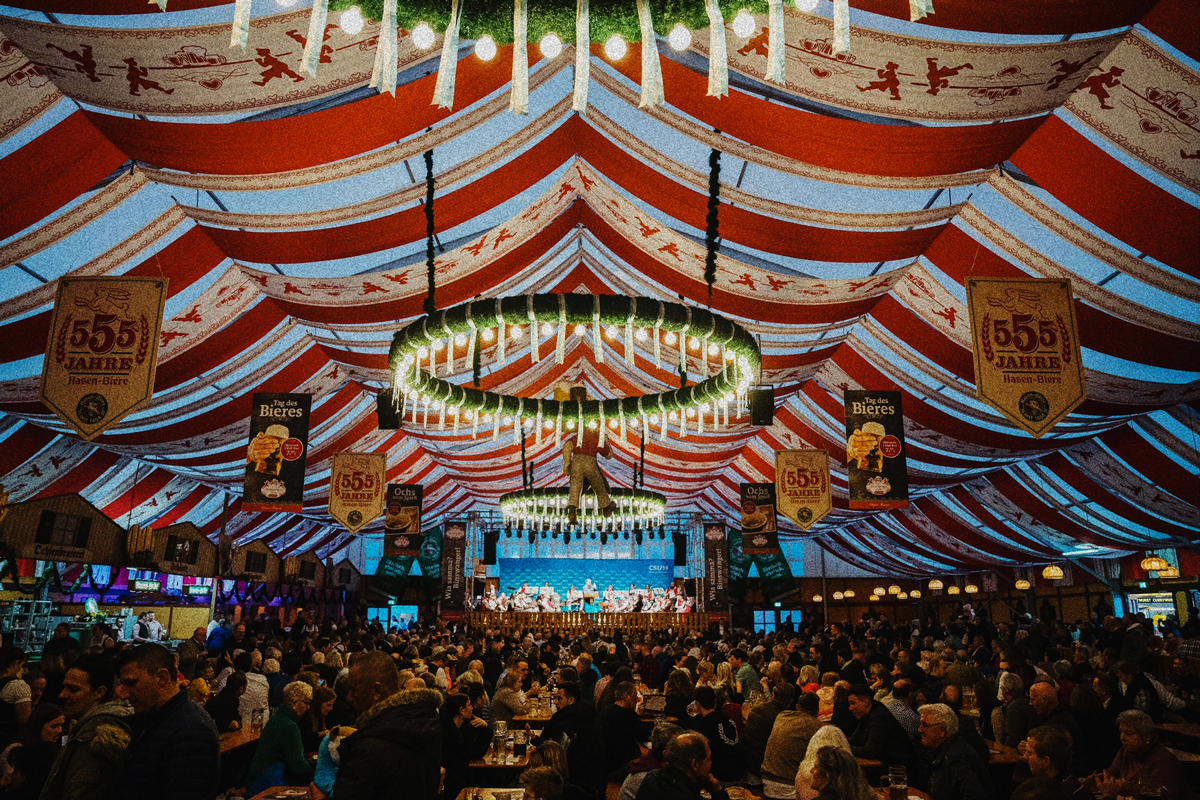
Although smaller than Oktoberfest, the Augsburger Plärrer remains one of the largest folk festivals in Bavarian Swabia, with its 1.2 million visitors per year.
The Plärrer is one of the so-called Volksfest, or “popular festivals,” but its origins date back long before this name was attributed to it.
Initially, it was a popular event not limited to a specific time of year, which every evening brought together people from all over Nuremberg within the city walls.
In 1878, protests from some citizens regarding the excessive noise led to everything not strictly related to the market being moved outside the city walls, near the city of Augsburg, southwest of Nuremberg.
It was then that the name Plärrer was adopted for the first time, derived from the German “plärren,” meaning “chatter,” replacing what had officially been the name of the festival until then: Gälparrer.
It was in that very year that it was officially born as a festival, where not only jugglers and magicians gathered, but also true figures from the circus scene, such as the world’s smallest man (only 78 cm tall), present at the fair in 1969.
The German writer and playwright Bertolt Brecht also reported having frequently attended the Augsburg Plärrer and being so fascinated by it that he wrote a short poem, the “Plärrerlied,” in honor of traditional folk festivals.
With the end of the First World War, the ban on consuming alcohol was extended until 1927, when blueberry wine finally began to be served again and the first beer stall appeared. But the first actual beer tent was only built around 1930, though not without protests and anti-alcohol campaigns that many believed threatened the moral decay of the citizens.
In 1968, a project was implemented that proposed serving beer in plastic mugs to avoid brawls and prevent them from being thrown. In the following year’s edition, this proposal was eliminated.
But what beer do people drink at the Augsburger Plärrer? A Festbier!
These are the typical beers of traditional German festivals, made with the last malts remaining in March or April that are used for brewing.
A Festbier is a slightly coppery beer, with an alcohol content a bit higher than other beers (5.6%). It is well-suited to being drunk from glass mugs without risking the loss of any of its organoleptic properties. The mugs, in fact, allow for a good grip thanks to the wide handle, preventing the beer from warming up through contact with the hands.
This year, for the first time, you can find Hasen Festbier in the best QBA venues, to celebrate just like at the real Bavarian folk festivals.
Currently, it features two annual editions: one in spring, called Frühjahr, which coincides with the Easter weekend; and one in summer between late August and early September, called Spätsommer.
Each edition features approximately 80 food stalls and games, two of which are very large beer tents where it is possible to reserve seats to eat traditional food: the Festzelt Schaller and the Binswanger Zelt.
The Plärrer officially begins with the “tapping” of the barrel by the mayor of the city of Augsburg and the parade that opens the festivities on the first day.
In this case too, like all folk festivals, people are invited to wear traditional clothing, such as Lederhosen (“leather trousers”) and Dirndl (“dress with apron”) in full Bavarian style, while sipping beer and eating traditional food.
Now all that’s left to say is: O’zapft is!