
defining beer aromas and flavors

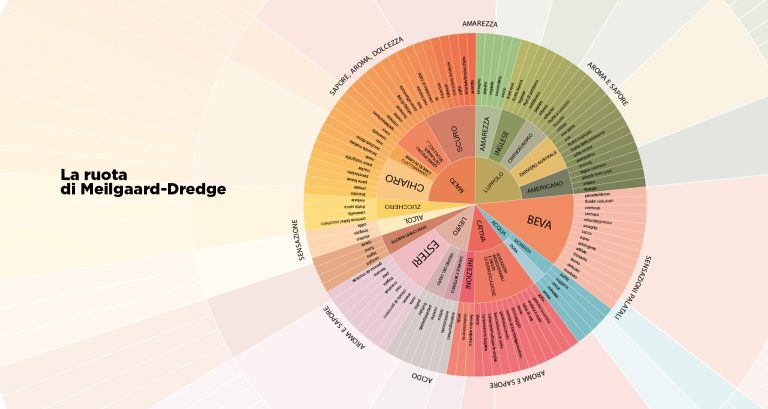
the Meilgaard - Dredge wheel

Danish scholar Meilgaard was among the first to develop a method to enable everyone to describe beer aromas and flavors analytically. Let’s discover what it is.

How to Describe a Beer

It’s an experience that has happened to everyone at least once in their life: not finding the right words to describe and highlight the characteristics of a beer or another beverage.

If you are not a professional taster, naming aromas and flavors can represent a difficult challenge that suddenly makes you feel illiterate. Words fail and the only path to follow is improvisation.

However, there are tools that allow you to overcome this lack of preparation and teach you, with a bit of practice, to name what our main senses—smell, touch, and sight—perceive.

What Are Aroma Wheels For

Aroma wheels were created with the objective of identifying universal terminology to objectively describe the sensations produced by tasting a food or beverage.

The first aroma wheel was created in 1974 thanks to the inventiveness of Ann C. Noble, a chemist at the University of California. Her work focused on sensory analysis applied to wine tasting and immediately achieved significant success both inside and outside the academic world, involving technicians as well as curious and enthusiastic individuals eager to approach the world of wine.

The wheel consisted of twelve aromatic families, each subdivided into a series of more specific sub-families that in turn led to unique descriptors. The scheme represented a reference point for subsequent scholars who applied sensory analysis to new foods and beverages such as oil, whisky, champagne, chocolate, coffee, tea, and finally beer.

The Meilgaard-Dredge Aroma Wheel

The Meilgaard-Dredge wheel represented the first tool for sensory analysis of beer and made an important contribution to describing the beverage’s aromas and flavors.

Invented by Danish physician Morten Meilgaard, it is divided into fourteen sectors that group the main sensory perceptions induced by beer.

How Is It Represented?

It consists of a circle divided into two segments of different sizes: the larger one refers to smell; the smaller one to taste. From the two main segments, others branch outward in different sizes and colors: most belong to the smell section, while others belong exclusively to the taste/flavor section. In some segments, there is a blend of smell and flavor indicating that these particular notes can be detected through both smell and taste. The wheel is completed with an outer section formed by rays, each representing a specific descriptor.

Today, the Meilgaard wheel is considered outdated in favor of other schemes, mainly due to its difficulty of application. Nevertheless, it continues to be an important tool for evaluating “off flavors”, the olfactory notes that indicate defects in beer.